Privacy in a hospital isn’t just about modesty—it’s tied to dignity, comfort, and even trust. Patients are often at their most vulnerable, and something as simple as a curtain or privacy screen can make a big difference in how safe they feel.
In shared hospital wards, where multiple beds sit just a few feet apart, creating personal space is tricky. A well-placed partition becomes more than just a divider—it’s a buffer for confidentiality, a shield during a procedure, and sometimes even a bit of emotional relief.
And yes, it also helps with those very human moments—like conversations, dressing, or even audible bodily functions—that patients would rather keep private. That’s where thoughtful design in healthcare settings really shows up.
What Are Hospital Curtains? Features and Benefits
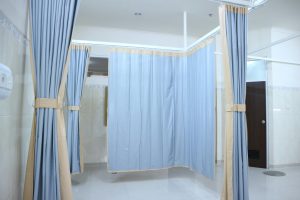
A hospital curtain is probably the first thing that comes to mind. You’ve seen them—soft fabric panels suspended from ceiling tracks, sliding around a bed to create an instant cubicle.
These privacy curtains are popular for a reason. They’re simple, effective, and quick to use. Staff can pull a curtain closed in seconds, creating a lightweight visual barrier without interrupting workflow.
Because they’re made from curtain fabric, they also soften the room a bit. Hospitals can feel sterile and harsh, so that subtle touch matters more than people think.
But there’s a trade-off. Fabric can become contaminated over time. Without proper hygiene routines, curtains may collect bacteria, especially in high-touch areas. That’s why many facilities rotate disposable curtains or schedule regular wash cycles to keep things clean.
Still, when flexibility is key, it’s hard to beat them. Curtains are designed to open fully, close completely, and adapt to different bed layouts with very little effort.
What Is a Privacy Screen? Key Characteristics
A privacy screen takes a different approach. Instead of hanging from above, it stands on the floor as a mobile panel that can be moved wherever it’s needed.
Most medical privacy screens are built with a hard surface, sometimes with antimicrobial coatings. That makes them durable and easier to disinfect compared to fabric options.
They’re also incredibly practical in fast-moving environments. Need to create a temporary barrier? Just roll a privacy screen into place. No mounting, no installation, no waiting.
Of course, they’re not perfect. Because they don’t fully wrap around a bed, there can be a small gap that affects the level of privacy. For some situations, that matters. For others, it’s a non-issue.
Still, as an alternative to hospital curtains, they offer a solid mix of mobility and hygiene.
Infection Control and Hygiene Considerations
If there’s one area where the decision really counts, it’s infection control.
Curtains, by nature, are porous. They can contaminate and hold onto bacteria if not handled properly. In a busy hospital, where multiple patients and staff interact with the same curtain throughout the day, that risk adds up.
That doesn’t mean they’re unsafe—it just means they need consistent attention. Regular laundering, proper handling, and scheduled replacement are all part of keeping them hygienic.
Privacy screens, especially hard surface privacy screens, have an advantage here. They can be wiped down and disinfected thoroughly between uses. That’s a big deal during an outbreak or in areas where contamination risks are higher.
So the choice often comes down to how much ongoing maintenance your team can realistically manage.
Flexibility, Mobility, and Space Efficiency
This is where things get interesting, because both options shine—just in different ways.
Curtains are great when your layout is fixed. In hospital wards with permanent bed arrangements, they create a seamless partition that can open or close as needed without taking up floor space.
Privacy screens are better when things change often. Their mobile design makes them ideal for temporary setups, quick procedures, or spaces that need to shift throughout the day.
That said, screens do take up some room. When not in use, they need to be stored somewhere. Curtains, on the other hand, stay out of the way when opened.
So it’s really about how your space functions. Static layout? Curtains work beautifully. Constant movement? Screens might be the better fit.
Cost, Maintenance, and Long-Term Investment
At first glance, a hospital curtain usually looks like the more budget-friendly option. Lower upfront cost, easy installation—it checks the obvious boxes.
But the full picture takes time to see.
Curtains come with ongoing maintenance costs. They need to be removed, washed, and sometimes replaced due to wear or tear. Over the life cycle of the product, those expenses can stack up.
Privacy screens cost more at the start, but they’re built to last. Their durable surface doesn’t require laundering, and they hold up well in high-traffic environments. That can mean real savings over time.
So instead of just comparing price tags, it helps to think about long-term investment and how each option fits into your daily operations.

Choosing the Right Solution for Your Facility
There’s no one-size-fits-all answer here.
If your priority is full coverage, softness, and a clean visual enclosure, a hospital curtain makes sense. It’s especially effective in shared rooms where patient privacy needs to be consistent and reliable.
If your focus leans toward hygiene, durability, and quick adaptability, a privacy screen might be the better solution.
In reality, many healthcare facilities use both. Curtains for permanent bed spaces, screens for temporary or flexible needs. It’s not about choosing one over the other—it’s about using the right tool in the right place.
For facilities looking for a dependable partner, Drapery Manufacturing Inc. (DMI) brings decades of experience to the table. Since 1975, they’ve specialized in custom cubicle curtain solutions, along with measuring, manufacturing, and installation services. Their work across hospitality, multi-housing, and commercial sectors—including healthcare facilities—aligns well with the practical demands of hospital environments.
Make the Right Call for Patient Care
At the end of the day, this decision isn’t really about a curtain versus a privacy screen. It’s about what works best for your patients, your staff, and your space.
Think about how your hospital operates. Consider hygiene protocols, room layout, and how often things need to change. Look beyond the upfront cost and factor in maintenance, durability, and daily use.
The right choice will feel obvious once it aligns with your workflow.
And when it does, that simple barrier—whether it’s a curtain or a screen—quietly becomes part of better patient care.